
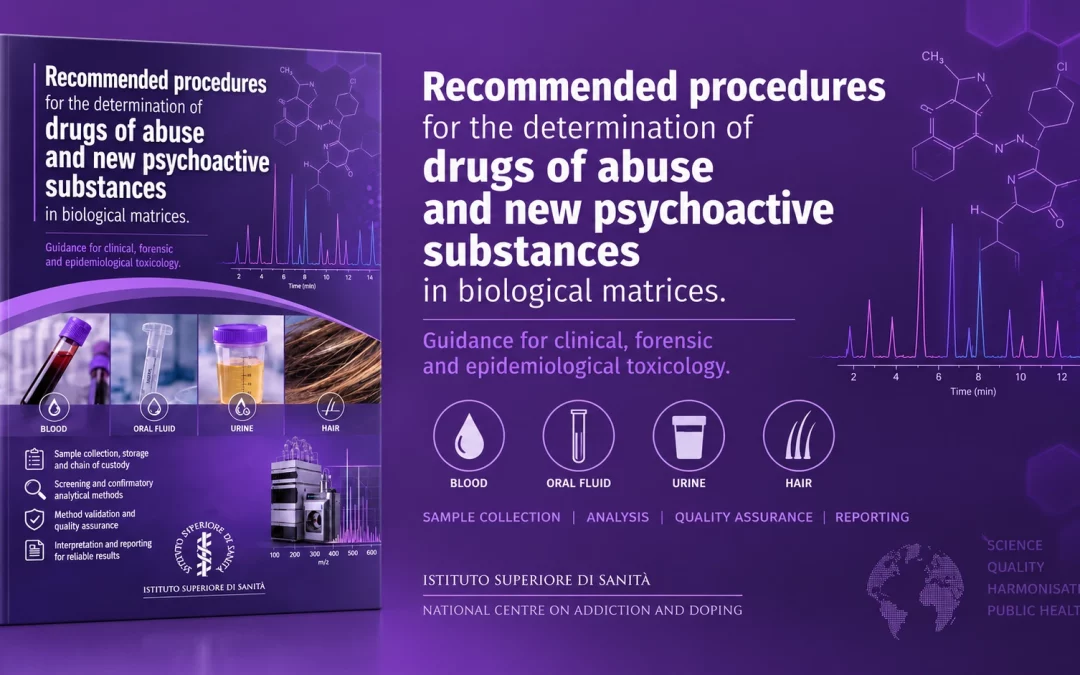
The determination of drugs of abuse and new psychoactive substances in biological matrices is one of the most complex and rapidly evolving areas of analytical, clinical and forensic toxicology. The increasing variety of substances available on the market, the continuous emergence of new compounds, changing patterns of use and the growing diversity of contexts in which toxicological testing is required make it essential to have access to up-to-date, harmonised and methodologically rigorous procedures.
Within this framework, the manual “Recommended procedures for the determination of drugs of abuse and new psychoactive substances in biological matrices” was developed by Emilia Marchei, Maria Concetta Rotolo, Paolo Berretta, Chiara Fraioli, Simona Pichini and Manuela Pellegrini, from the National Centre on Addiction and Doping of the Istituto Superiore di Sanità. The document was designed to provide a technical, scientific and operational reference for the determination of drugs of abuse and New Psychoactive Substances (NPS) in the main biological matrices used in toxicology.
An integrated approach to the entire toxicological process
The manual addresses the entire analytical pathway, from the pre-analytical phase through to the interpretation and communication of results. The approach adopted does not consider instrumental analysis as an isolated process, but rather as one component of a broader sequence in which the quality of the final result also depends on the correct selection of the biological matrix, appropriate collection procedures, sample storage, documentation, traceability and the application of validated analytical procedures.
The overall aim is to promote the harmonisation of laboratory procedures, thereby improving the consistency, comparability, reproducibility and medico-legal validity of results obtained in different application settings. Particular attention is devoted to the need for sufficiently sensitive and specific analytical approaches capable of responding to the continuous evolution of the NPS market, which is characterised by substances that are often structurally different from those traditionally investigated and that may not always be detected by conventional screening systems.
Clinical, forensic, epidemiological and public health applications
Toxicological analysis of psychoactive substances is applied in a wide range of settings, each characterised by specific analytical and interpretative objectives.
In the clinical setting, toxicological testing may be used to rapidly identify the substances responsible for acute intoxication, support therapeutic management, monitor adherence to pharmacological or rehabilitation programmes, and contribute to the assessment of severity and prognosis.
In the forensic and medico-legal setting, analyses may be performed to investigate substance use in relation to driving, assess patterns of consumption, examine biological samples within judicial proceedings, or detect substances in cases involving suspected non-consensual administration.
In the field of public health and epidemiological surveillance, toxicological data can contribute to the identification of emerging trends in substance use, the monitoring of NPS diffusion and the planning of health and regulatory interventions. Additional applications include occupational medicine and safety-sensitive activities involving specific responsibilities or risks.
The main biological matrices
A central part of the manual is devoted to the principal biological matrices used in toxicological practice: blood, oral fluid, urine and keratin matrices, particularly hair.
The choice of matrix is not regarded as a merely technical decision, but is directly related to the question that the toxicological investigation is intended to answer. Different matrices provide different types of information according to their detection window and their ability to relate the presence of a substance to the timing of intake.
Blood is of particular importance in clinical and forensic settings where recent exposure must be assessed and, within the limitations imposed by the pharmacokinetics of the substance, a possible relationship with the individual’s psychophysical condition may need to be evaluated.
Oral fluid enables relatively simple and non-invasive collection and is particularly useful in settings where recent substance use needs to be investigated.
Urine is one of the most commonly used matrices in drug testing because of its longer detection window and the relatively high concentrations of metabolites that may be present. However, its interpretation requires caution, particularly when attempting to infer the precise timing of substance intake.
Keratin matrices, especially hair, make it possible to extend the observation period and may be used to document past exposure or prolonged patterns of use. The manual also gives specific attention to hair collection in cases of Drug-Facilitated Crime, in which the timing of sample collection and segmental analysis may be particularly relevant.
For each matrix, the document describes collection procedures, storage conditions, the main factors that may compromise sample integrity and the principal non-conformities that may affect the validity or interpretation of analytical results.
Ethanol consumption and direct and indirect biomarkers
The manual also includes a specific section dedicated to the assessment of ethanol consumption, distinguishing between current, recent and past or continuous use.
Different biomarkers are considered according to the relevant detection window. Current consumption is assessed through blood ethanol determination; recent consumption is investigated through urinary ethyl glucuronide (EtG) and ethyl sulfate (EtS); and medium- to long-term consumption is evaluated using hair EtG, Fatty Acid Ethyl Esters (FAEE), blood phosphatidylethanol (PEth) and selected indirect biomarkers.
The proposed approach highlights the importance of interpreting analytical findings in relation to the clinical or medico-legal question and, where appropriate, integrating laboratory data with medical history and other relevant information.
Screening and confirmatory analyses
A substantial part of the document is dedicated to the distinction between screening methods and confirmatory analyses.
Screening methods allow large numbers of samples to be analysed rapidly and can provide a preliminary indication of the possible presence of certain classes of substances. However, the manual stresses that these results must be interpreted in light of the intrinsic limitations of the analytical systems used.
This issue is particularly relevant in the case of NPS, since many emerging substances are not detected by traditional immunochemical tests because of their structural variability and the absence of specific antibodies. For this reason, chromatographic methods coupled with mass spectrometry play a central role, providing greater selectivity and broader analytical coverage.
Confirmatory analyses are intended to achieve unambiguous identification and, where required, accurate quantification of parent compounds and their metabolites. The document describes the use of techniques such as gas chromatography-mass spectrometry (GC-MS), liquid chromatography-tandem mass spectrometry (LC-MS/MS) and high-resolution mass spectrometry (HRMS), emphasising the importance of internal standards, appropriate identification criteria and analytical limits suited to the specific context of application.
The manual also provides reference cut-off values for different substances and biological matrices.
Method validation and quality assurance
Analytical quality is one of the core principles of the manual.
Particular emphasis is placed on the need for methods to be appropriately validated before routine application and for analytical performance to be documented in a transparent and verifiable manner.
The parameters considered include sensitivity, specificity, precision, accuracy, limits of detection and quantification, linearity, recovery and potential matrix effects. The manual also underlines the importance of Internal Quality Control (IQC) and External Quality Assessment (EQA) programmes, which are essential for monitoring laboratory performance over time and improving comparability of results between different facilities.
Quality assurance is not limited to the instrumental phase but applies to the entire analytical process, from sample collection through to the issuing of the final report. The reliability of a toxicological result is therefore regarded as the product of an integrated system of control, documentation, traceability and verification.
Documentation, informed consent and chain of custody
One of the features that particularly characterises the manual is the attention devoted to the documentation accompanying toxicological testing.
The document describes the principal requirements relating to informed consent, personal data protection information, sample collection records, the chain of custody and reporting.
The chain of custody is particularly important in forensic contexts, as it allows every stage in the handling of the sample to be documented, from collection and transfer to reception by the laboratory and subsequent analysis, storage or disposal. The proposed model records the individuals involved, dates and times, sample conditions, transport procedures and any anomalies, with the aim of ensuring sample integrity and full traceability.
The manual also addresses the correct communication of results, indicating that the analytical report should clearly specify the biological matrix analysed, the analytical method used, the substances investigated, the results obtained, relevant reference values or cut-offs, units of measurement and, where appropriate, measurement uncertainty.
The reporting form included in the document also provides for situations in which a result cannot be interpreted because of insufficient sample volume, degradation or analytical interference.
A manual with a strong operational focus
The structure of the document is not exclusively descriptive. Two appendices reinforce its practical and operational value.
Appendix A is devoted to Recommended Standard Operating Procedures, providing operational guidance for the determination of psychoactive substances in different biological matrices and for quantitative data analysis.
Appendix B contains examples of forms that may be used as references for the documentation of the analytical process, including informed consent, privacy information, biological sample collection records, chain-of-custody forms and analytical reporting forms.
This structure directly connects methodological principles with day-to-day laboratory activities, providing not only theoretical guidance but also practical tools aimed at supporting process standardisation.
The challenge of New Psychoactive Substances
A cross-cutting theme throughout the manual is represented by New Psychoactive Substances.
The rapid appearance of new compounds, the diversity of their chemical structures, the presence of metabolites that are not always fully characterised and the sometimes limited availability of analytical reference standards make NPS monitoring particularly challenging.
The document highlights how this rapidly evolving scenario requires sensitive and adaptable analytical methods, continuous professional training, collaboration between laboratories and effective information sharing.
Within this perspective, the manual also refers to recent developments in analytical instrumentation and to the potential contribution of innovative approaches, including artificial intelligence and machine learning, for the identification and characterisation of emerging substances.
A tool for the harmonisation of analytical toxicology
The overall value of the manual lies in its ability to bring together, within a single document, the pre-analytical, analytical, quality-related, documentary and medico-legal aspects involved in the determination of drugs of abuse and NPS in biological matrices.
Its objective is not to propose a single analytical methodology applicable indiscriminately to every setting, but rather to provide a shared reference framework that allows laboratories to adopt procedures appropriate to the purpose of the investigation while maintaining high standards of quality, transparency and traceability.
The manual therefore represents a resource for professionals working in analytical and forensic toxicology, clinical laboratories, researchers, healthcare professionals and institutions involved in the monitoring of psychoactive substances, with the aim of promoting a common methodological approach and improving the comparability of toxicological data.
In a field characterised by continuous change, the harmonisation of procedures has a significance that extends beyond the laboratory itself. The production of reliable and correctly interpreted analytical results contributes to clinical decision-making, safeguards the medico-legal validity of toxicological investigations, supports epidemiological surveillance and, more broadly, contributes to the protection of public health and collective safety.